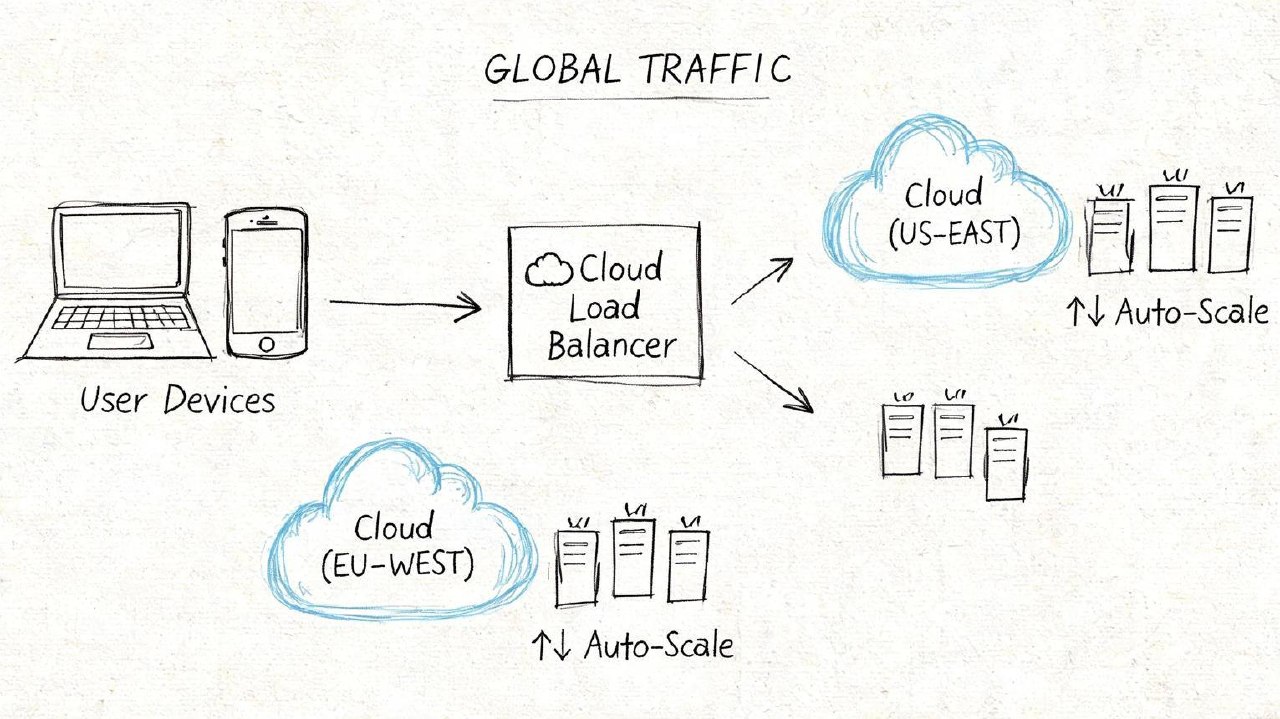
Imagine that millions of people suddenly open YouTube, Amazon, GitHub, or Netflix at exactly the same moment.If every request were sent to a single server, that server would quickly run out of CPU, memory, and network capacity. Pages would become slow, requests would fail, and eventually the website could go offline.Yet, this rarely happens.One of the biggest reasons is a piece of infrastructure called a load balancer.The ProblemThink of a popular restaurant with only one cashier.Even if the kitchen can prepare food quickly, customers still form a long line because everyone must go through the same person.Web servers face the same problem.When thousands—or even millions—of users send requests simultaneously, one server becomes a bottleneck.Large technology companies solve this problem by running many servers instead of relying on just one.But another question appears:**How does the system decide which server should handle each request?**That's where the load balancer comes in.**What Is a Load Balancer?**A load balancer is a traffic manager that sits between users and backend servers.Instead of users communicating directly with a server, every request first reaches the load balancer.The load balancer then chooses one of several healthy servers to handle the request.Instead of this The architecture becomes
Users
│
▼
Server
the architecture becomes
:Users
│
▼
Load Balancer
/ | \
▼ ▼ ▼
Server A Server B Server C
-
No single server receives every request.The workload is distributed across multiple machines.**How Does It Choose a Server?**Different strategies exist depending on the application's needs.Round RobinThe load balancer sends requests one after another.Request 1 → Server ARequest 2 → Server BRequest 3 → Server CThen it repeats.Simple and effective when servers have similar capacity.Least ConnectionsInstead of taking turns, the load balancer checks which server currently has the fewest active users.That server receives the next request.This is useful when some requests take much longer than others.Weighted Load BalancingNot every server has the same hardware.Imagine:Server A: 32 CPU coresServer B: 16 CPU coresServer C: 8 CPU coresA weighted load balancer gives more traffic to the most powerful server instead of treating every machine equally.Health ChecksOne of the smartest features of a load balancer is that it constantly checks whether servers are healthy.Imagine Server B crashes.Without a load balancer, many users would receive errors.With health checks, the load balancer notices the failure within seconds and stops sending traffic to that server.Users continue using Servers A and C without even noticing something went wrong.This is one reason modern websites remain available even when individual machines fail.How Big Tech Uses Load BalancersCompanies like Netflix, GitHub, Amazon, Google, and many cloud platforms don't rely on a single load balancer or a handful of servers.Instead, they operate fleets of servers across multiple data centres and regions.Requests are distributed across many machines, unhealthy servers are automatically removed from rotation, and new servers can be added as demand grows.The exact architecture varies from company to company, but the core idea remains the same
-
:No single server should become a single point of failure.Why Every Backend Developer Should Learn ThisWhen you first build a Node.js or Express application, one server feels enough.As traffic grows, that assumption changes.Understanding load balancers helps explain:Why websites stay online during traffic spikes.How applications scale to millions of users.Why cloud platforms can replace failed servers automatically.How modern backend systems achieve reliability.It's one of the first concepts that shifts your thinking from writing code to designing systems.Final ThoughtsA load balancer doesn't make your application faster by itself.Instead, it makes your application more reliable, more scalable, and more resilient.Every time you open a website that responds instantly—even while millions of other people are using it—there's a good chance a load balancer is quietly doing its job behind the scenes.The best infrastructure is often the infrastructure users never notice.